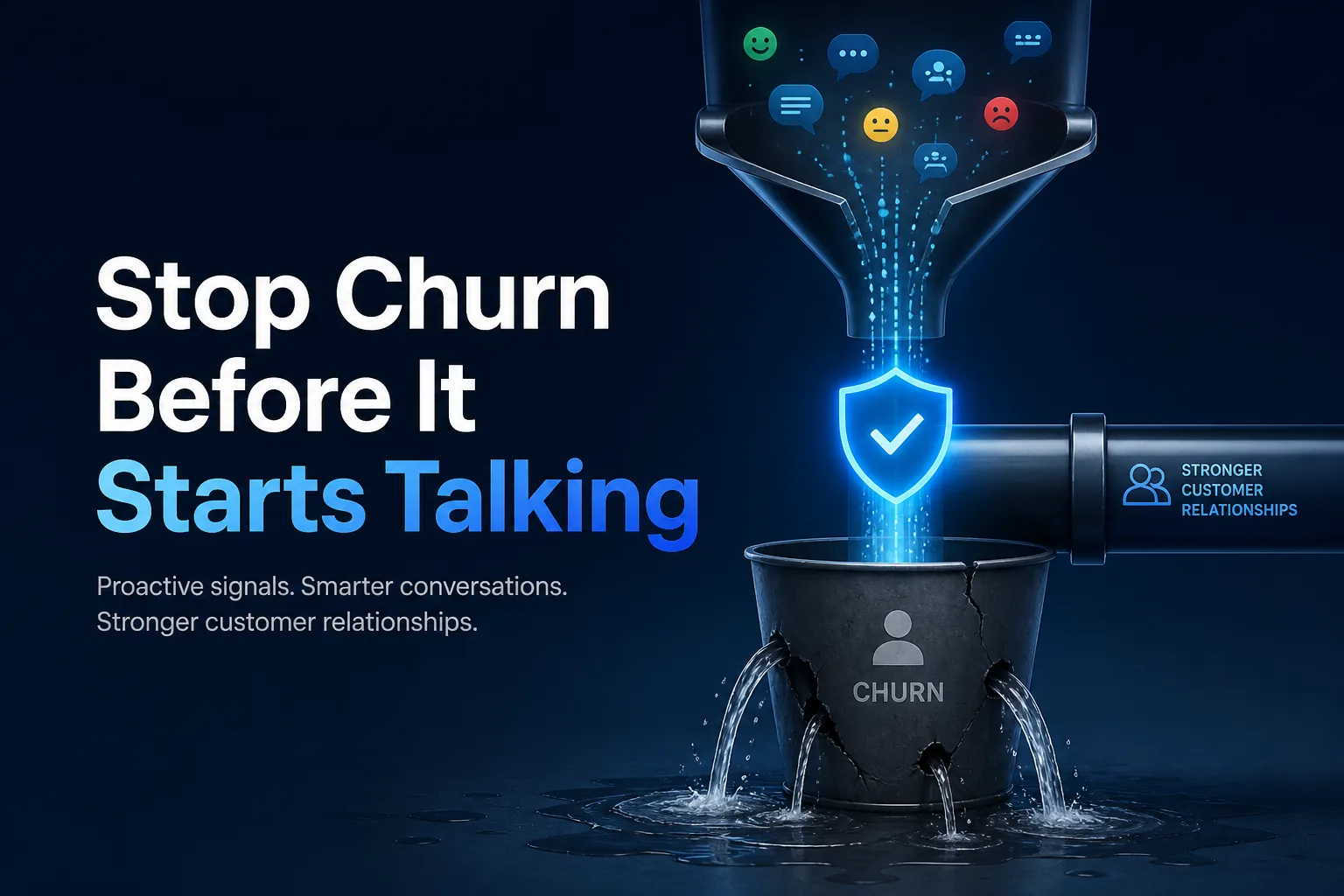
Churn doesn't announce itself. Your tools already know.
By the time a customer sends the cancellation email, the signal has been sitting in your data for weeks — buried across four platforms that never talk to each other. A call where the champion went quiet. A health score that dipped three Fridays in a row. A renewal conversation that keeps getting rescheduled. A feature adoption metric that flatlined in ChurnZero.
The challenge isn't data. It's synthesis. GTM teams have too many signals scattered across too many tools, with no connective tissue to transform noise into a coordinated save motion. This is exactly the problem n8n was built to solve — and when you connect it to Gong's conversation intelligence, ChurnZero's behavioral telemetry, and Slack's real-time reach, you get a churn radar that actually works.
"The average enterprise loses 3–5% of revenue to churn that was detectable 30–60 days before it happened. The signals were there. The workflow wasn't."
Four tools, one pipeline, zero manual triage
The system works in three layers: detect signals in Gong and ChurnZero, score risk in n8n using weighted logic, then route alerts to the right Slack channel with full context and a clear next action.
Detects signal
Health score
Scores & routes
Alerts CSM
Reading the room from conversation data
Gong is your earliest warning system. Before any metric changes, tone changes. Gong's trackers and API let you pull structured signals from every call — sentiment shifts, keyword flags, talk-time ratios, and topic trends that correlate with churn risk.
Configure these Gong trackers as your primary churn signals, then expose them via the Gong API to your n8n workflow:
Competitor mentions
Any mention of named competitors in the last 60 days. Weight: High. Combine with deal stage for urgency.
Champion change signals
"We have a new VP," "our team restructured," "I'm no longer the decision-maker." Auto-flag these phrases.
Negative sentiment trend
Three consecutive calls with declining sentiment scores below 40%. The trend matters more than any single score.
Low engagement talk-time
Customer talk-time drops below 30%. A quiet customer in a QBR is rarely a satisfied one.
ROI / value challenges
"Are we getting value," "hard to justify the cost," "budget pressure." Phrases that precede renewal challenges.
Meeting avoidance
Two or more reschedules or no-shows on CSM calls in a 30-day window. Disengagement before disappearance.
Pull these via the Gong API's /v2/calls and /v2/calls/extensive endpoints. Schedule your n8n HTTP Request node to poll every 4 hours, or use Gong webhooks if you're on an enterprise tier for real-time delivery.
Behavioral telemetry that Gong can't see
ChurnZero fills in the blind spots — what happens between calls. Product usage patterns, health score trajectories, NPS trends, and renewal proximity all live here. Your n8n workflow should pull from ChurnZero's REST API on a scheduled basis and merge this data with Gong signals into a unified risk profile.
| Signal | Threshold | Risk Weight | Source |
|---|---|---|---|
| Health Score | Below 50 for 14+ days | 30 pts | ChurnZero |
| Feature adoption drop | >40% decline month-over-month | 25 pts | ChurnZero |
| Login frequency | Zero logins in last 21 days | 20 pts | ChurnZero |
| NPS score | Detractor (0–6) | 15 pts | ChurnZero |
| Negative sentiment call | Score below 40 | 20 pts | Gong |
| Competitor mentioned | Any mention in last 60 days | 30 pts | Gong |
| Renewal proximity | Within 90 days | Multiplier ×1.5 | ChurnZero |
Use ChurnZero's /api/v2/accounts endpoint to pull health scores and usage metrics. Map account IDs between ChurnZero and Gong using your CRM's account identifier as the join key — this is the critical piece of data engineering that makes the merged risk score possible.
The orchestration layer that ties it all together
n8n is the connective tissue. A single workflow polls both Gong and ChurnZero, merges signals by account, calculates a composite risk score, applies routing logic, and pushes a structured Slack alert — all without writing a backend service or managing infrastructure.
The IF node downstream filters to only accounts with a risk score at or above 60. Scores below that threshold get logged to a Google Sheet for weekly review — you don't want to flood Slack with noise, only send what requires human action today.
Alerts that drive action, not just awareness
The Slack message is where most teams fail. They push a raw data dump that nobody acts on. A well-designed churn alert answers four questions in under 10 seconds: who is at risk, why, how urgent, and what should I do right now.
Route alerts to different channels based on severity: #cs-churn-alerts for High and Critical, #cs-weekly-watch for Medium scores reviewed in the weekly standup. Tag the account owner directly in Critical alerts — passive channel monitoring isn't enough when $80k of ARR is at stake.
How to ship this in two weeks
- Week 1, Day 1–2: Stand up n8n (self-hosted or cloud). Configure Gong API credentials and test the
/v2/calls/extensiveendpoint. Validate that you can pull structured call data for a sample account. - Week 1, Day 3–4: Connect ChurnZero API. Map account IDs between Gong, ChurnZero, and your CRM. This cross-system join is the most important technical step — invest time here.
- Week 1, Day 5: Build the n8n Code node with your scoring logic. Start with 3–4 signals only. Validate scores against 10 known at-risk accounts from your last quarter.
- Week 2, Day 1–2: Wire the Slack output. Send test alerts to a private channel. Get feedback from 2–3 CSMs on the format.
- Week 2, Day 3–4: Tune thresholds and routing. Set the schedule. Add error handling and a fallback log to Google Sheets for missed alerts.
- Week 2, Day 5: Go live on your highest-ARR segment first. Run for two weeks before expanding to your full book of business. Measure false-positive rate weekly and adjust weights.
What teams using this stack typically see
"The goal isn't to automate customer success — it's to give CSMs a head start. When the signal arrives in Slack before the customer considers leaving, you're playing offense instead of defense."
Build the radar, not just the alarm
Most teams build reactive alerting — they learn about churn risk when it's already a crisis. The four-tool stack described here builds a radar: a continuous, automated system that reads weak signals before they compound into strong ones.
Gong hears what customers say. ChurnZero sees what they do. n8n connects the dots. Slack puts the right information in front of the right person at the right time. None of these tools alone tells the full story. Together, wired correctly, they give your CS team a meaningful head start on every renewal conversation that matters.
Ship the first version fast. Tune it weekly. The signal is already in your data.